Auto ignition gas stoves can make everyday cooking more convenient, but the built-in ignition mechanism adds parts that may need maintenance or repair. The likely drawbacks depend on whether the model uses a battery, a mechanical piezo igniter or mains-powered ignition. This guide explains common disadvantages, how to reduce avoidable problems, what you can safely check, and when a technician should take over. For a step-by-step explanation of the technology, see our What Is an Auto-Ignition Gas Stove and How Does It Work?
Written by Abdul Khader, researcher and writer at Gas Stove Hub. Last updated: October 27, 2026
Quick Answer: What Are the Main Disadvantages?
The main disadvantages are extra cost, a possible battery replacement, a spark mechanism that can fail, and sensitivity to moisture or food residue around ignition components. Mains-powered models may also depend on household electricity, while battery and piezo systems may continue sparking during a power cut. These issues are not identical on every stove, and auto ignition by itself does not guarantee that gas will shut off if a flame goes out. Check the manual for the exact ignition type and any flame-failure safety device.
Main Disadvantages of Auto-Ignition Gas Stoves
Not every model has the same drawbacks. Battery-powered systems need a compatible replacement battery, piezo systems have a mechanical spark mechanism that can wear, and mains-powered systems may rely on household electricity. Moisture, grease, incorrect cleaning and normal wear can also affect ignition performance. Treat the points below as model-dependent possibilities rather than faults that every auto-ignition stove will develop.
| Possible Disadvantage | Why It Matters | Practical Response |
|---|---|---|
| Higher purchase price | The ignition assembly can add to the cost compared with a basic manual model. | Compare the same stove range with and without auto ignition and decide whether the convenience is worth the difference. |
| Battery replacement on some models | A weak battery may cause delayed or weak sparking. | Use the battery type specified in the manual and follow its replacement instructions. |
| Igniter or switch wear | Electrical contacts, the spark generator or a mechanical igniter may wear or fail. | Use authorised service if a new correct battery and external cleaning do not resolve the problem. |
| Moisture and residue sensitivity | Spills, grease or cleaning liquid near ignition components may interfere with sparking. | Clean only as the manufacturer recommends and let parts dry completely before reuse. |
| Power-cut dependence on some models | Mains-powered ignition may not spark without electricity. | Check the ignition type before buying and follow the manufacturer’s approved lighting instructions. |
| Ignition is not the same as gas-leak protection | Auto ignition creates a spark but does not automatically mean the stove has flame-failure protection. | Check whether the exact model includes a Flame Failure Device and understand its limits. |
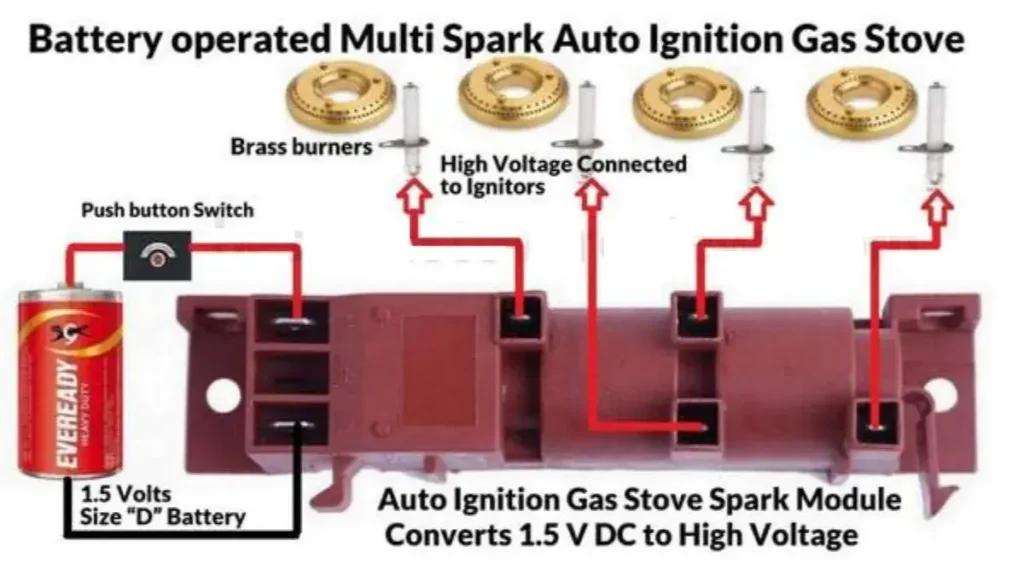
Disadvantages of Battery-Powered Auto Ignition
These drawbacks mainly apply to battery-powered systems. Battery sizes and replacement steps differ by model, so do not assume every stove uses an AA or D-size battery. Piezo ignition does not use a battery, while mains-powered ignition depends on the household electrical supply. Check the product label or manual to identify the system before troubleshooting.
- Battery replacement. Battery-powered models need a replacement when the battery becomes weak. The recommended interval and battery type vary, so follow the manufacturer’s manual rather than a universal schedule.
- Moisture-related ignition problems. Spills or cleaning liquid near the spark electrode, switch or electrical parts may cause intermittent sparking or prevent ignition. This does not necessarily mean the battery is draining faster.
- Spark electrode contamination or wear. Grease, food residue, moisture or wear may affect the spark. Allow the stove to cool and clean only accessible parts as directed in the manual.
- Ignition assembly failure. A spark generator, igniter or switch may eventually need professional inspection or replacement.
- Sticky controls. Oil or food residue around an external knob or ignition control can make operation difficult. Do not dismantle the control to clean inside it.
Practical Remedies for Each Problem
- Follow the cleaning instructions. Turn off the burners and let the stove cool fully before cleaning. Use only the method and products allowed by the manufacturer.
- Keep moisture away from ignition parts. Do not pour water over the stove or spray cleaning liquid into controls, electrodes or openings. Use a soft cloth and avoid soaking the surface.
- Prevent spills from reaching the control area. If milk or another liquid boils over, switch the appliance off safely and let it cool before cleaning according to the manual. Do not attempt ignition while parts remain wet.
- Keep accessible controls clean. Wipe the outside of knobs and the surrounding surface gently. Do not pry open a switch, remove internal wiring or poke metal tools into the ignition assembly.
- Use the correct replacement battery if fitted. Follow the manufacturer’s procedure and battery specification. Keep spare batteries only if your particular model uses them.
- Arrange service for recurring faults. If the correct battery and permitted external cleaning do not restore ignition, stop troubleshooting and contact authorised service.
Auto Ignition vs Manual Ignition: Is the Extra Cost Worth It?
Auto ignition is mainly a convenience feature. A manual-ignition model usually has a simpler mechanism and may cost less upfront, while an auto-ignition model lets you light the burner without reaching for a separate lighter or matchstick. The right value depends on the price difference, your preferred controls and the availability of service for the specific model.
| Factor | Auto Ignition | Manual Ignition |
|---|---|---|
| Lighting method | Built-in mechanism produces the spark | Requires a suitable lighter or matchstick |
| Purchase price | May cost more for otherwise comparable models | Often lower upfront cost |
| Maintenance | Battery or ignition parts may need attention, depending on type | Fewer built-in ignition components |
| Power-cut use | Depends on battery, piezo or mains-powered design | Does not rely on an electrical ignition system |
| Safety features | Auto ignition alone does not confirm flame-failure protection | Safety depends on the appliance design and correct use |
For a broader look at the benefits and disadvantages of auto ignition, see our Auto Ignition Gas Stove Advantages, Disadvantages and Buying Guide. To understand the difference between ignition convenience and other safety features, read Is an Automatic Gas Stove Safe?
Battery, Piezo and Mains-Powered Ignition Compared
Auto ignition is not a single design. Identifying the ignition system helps you understand maintenance needs and what may happen during a power cut.
| Ignition Type | Power Source | Common Trade-Off | Power-Cut Behaviour |
|---|---|---|---|
| Battery-Powered | Replaceable battery specified by the manufacturer | Battery needs eventual replacement; contacts and sparking parts can need service. | Usually can spark if the battery is charged and the system is in working order. |
| Piezoelectric | Mechanical action generates the spark | No battery to replace, but the mechanical igniter can wear or fail. | Does not rely on household mains electricity. |
| Mains-Powered | Household electrical supply | Needs a suitable power connection and may be unavailable if power fails. | May not spark during an outage. Follow the exact model’s manual for approved operation. |
Battery-Operated Ignition
Battery-powered systems use the battery size specified for that model to power the spark generator. The battery will eventually need replacement, and moisture or residue near ignition components can interrupt sparking. Do not assume every stove uses the same battery format or replacement interval. One manufacturer, for example, advises periodic battery replacement on its battery-operated hobs, but the correct timing for your stove is the one in its own manual.
Piezoelectric Ignition
Piezoelectric Ignition uses mechanical action to generate a spark and does not need a battery or household mains electricity. That removes battery replacement as a maintenance task, but the mechanical igniter and associated components can still wear or fail. If the spark becomes inconsistent, follow the manufacturer’s instructions and contact a technician when basic external checks do not solve the issue. The term “auto ignition” alone does not tell you which mechanism a stove uses.
Mains-Powered Ignition
Some built-in hobs use household electricity to operate the ignition system. Such a model may not spark during a power cut unless the manufacturer has designed another approved method. Electrical connections must be installed according to the product instructions. Do not modify wiring or improvise an ignition supply to make the hob work during an outage.
Safe Checks When Auto Ignition Fails
If a burner does not light, the cause may be a depleted battery, a wet or dirty electrode, a control issue or a failed ignition component. The following are limited, external checks only. Always follow the instructions for the specific appliance.
- Check the ignition type. Confirm whether the model uses a battery, piezo mechanism or mains power before assuming what is wrong.
- For a battery model, follow the manual. Replace the battery only if the instructions permit user replacement, using the exact specified type and polarity.
- Let wet parts dry completely. Turn the appliance off, allow it to cool, then clean and dry only accessible components as instructed. Do not energise or attempt to light a wet stove.
- Check the burner cap only if the manual permits it. Once cool, make sure removable parts are correctly seated and dry. Do not insert metal objects into the electrode or alter its position.
- Stop if the problem persists. Repeated clicking, no spark or repeated failure to light should be inspected by authorised service if the basic checks do not help.
For symptom-specific guidance, see our Auto Ignition Gas Stove Problems and Remedies guide. Do not open the stove body, reconnect internal wires, dismantle gas controls, alter the regulator or repair a gas connection yourself.
Power Cuts, Failed Ignition and LPG Safety
A power cut does not affect every auto-ignition stove in the same way. Battery-powered and piezoelectric systems may still spark when in working order, while a mains-powered system may not. Confirm the type in the manual before buying or depending on a particular method during an outage. Never improvise a lighting method that the manufacturer does not approve.
What to Do if Gas Flows but the Burner Does Not Light
Turn the burner control off immediately and do not keep releasing gas while repeatedly trying to ignite it. Follow the appliance manual before trying again. Do not attempt to locate a leak with a flame or repair the connection yourself.
If You Smell LPG or Suspect a Leak
Do not light a flame or operate electrical switches, appliances or battery-operated equipment. Move to a safe place and call the LPG emergency helpline on 1906. Follow official emergency instructions and do not return to the area to investigate until it is safe.
The Ministry of Petroleum and Natural Gas lists 1906 as the 24-Hour LPG Emergency Helpline. The Government of India’s LPG Safety Pledge also advises users to arrange periodic inspection by an authorised mechanic and avoid electrical or battery-operated equipment when LPG is suspected.
Auto Ignition Gas Stove Disadvantages FAQs
Do all auto ignition gas stoves have the same disadvantages?
No. Battery-powered models need a compatible battery; piezo systems rely on a mechanical igniter; and mains-powered systems may depend on household electricity. Moisture, residue and component wear can affect more than one type, so the actual drawbacks depend on the model and how it is maintained.
How often does the battery need replacing?
There is no single interval for every model. Follow the manufacturer’s recommended schedule and use only the specified battery. Elica, for example, recommends periodic replacement on its own battery-operated hobs, including a six-month interval in its guidance, but your stove’s manual should take priority. A weak or delayed spark may indicate a weak battery, although other faults can cause similar symptoms.
Can I prevent moisture damage to the ignition wiring?
You can reduce the risk by turning the appliance off, allowing it to cool completely, and using only the cleaning method permitted in the manual. Keep liquids away from ignition controls and electrodes, and do not attempt to light the stove while components are wet. If sparking remains unreliable after the parts are dry, contact authorised service.
Is it safe to open the stove and fix the wiring myself?
Do not open the stove body, reconnect wires, dismantle gas controls or alter the regulator. Limit checks to the user-maintenance steps in the appliance manual, such as replacing a user-accessible battery or cleaning accessible surfaces when cool. Have internal electrical or gas-related repairs handled by authorised service.
Why has my ignition switch stopped responding?
Oil or food residue around the external control may contribute, but a faulty switch or another ignition component can cause similar symptoms. Turn the appliance off, allow it to cool, and clean only the outside as the manual permits. Do not pry open the switch or spray cleaner into it. Arrange service if the control remains sticky or unresponsive.
Does Auto Ignition Prevent Gas Leaks?
No. Auto ignition creates a spark to light a burner. It does not, by itself, stop gas leaking from a hose, regulator, valve or connection. A Flame Failure Device, when fitted, is a separate safety feature intended to stop gas flow if a burner flame goes out. Check the exact model specification and have the installation inspected by an authorised technician.
What Should I Do if the Stove Keeps Clicking but the Burner Does Not Light?
Turn the burner control off if it has released gas without lighting. Do not keep releasing gas while repeatedly trying to ignite it. Once safe, follow the manual for any permitted external checks, such as whether a user-replaceable battery is weak or accessible parts are wet. If you smell LPG or suspect a leak, do not operate switches or appliances, move to a safe place and call 1906.
Does Auto Ignition Work During a Power Cut?
It depends on the ignition system. A battery-powered model may continue to spark if its battery is charged, and a piezo system does not rely on household electricity. A mains-powered system may stop sparking during an outage. Verify the exact type and follow the manufacturer’s approved instructions.
Conclusion
The disadvantages of auto ignition usually involve extra cost, maintenance of the ignition mechanism, battery replacement on some models, and possible sensitivity to spills or residue. Their relevance depends on the type of ignition and the care the appliance receives. Keep to the manufacturer’s cleaning and battery instructions, never open or modify the ignition or gas assembly, and use authorised service for faults that persist. If you are troubleshooting a specific symptom, read our Auto Ignition Gas Stove Problems and Remedies guide. For additional safety context, see Can Gas Stoves Explode?
Source & About This Guide
This guide was prepared for Gas Stove Hub to explain the trade-offs and basic user-maintenance limits of auto-ignition gas stoves. Ignition designs and replacement procedures differ, so the manual for your exact model should take priority. For additional reference, consult Elica’s Official Appliance Cleaning and Maintenance Guidance, the Government of India’s LPG Safety Pledge, and the Ministry of Petroleum and Natural Gas’s Official LPG Emergency Helpline Information. This article offers general consumer information and is not a substitute for the product manual, professional installation or authorised repair.